6.1 Sexually Transmitted Infections
Sexual health is an important public health issue with health, social
and economic impacts that can affect the people across the life course.
It is a fundamental aspect of human identity and life experience.
Wandsworth uses the World Health Organisation’s definition of sexual
health:
“A state of physical, mental and social well-being in relation to
sexuality. It requires a positive and respectful approach to sexuality
and sexual relationships, as well as the possibility of having
pleasurable and safe sexual experiences, free of coercion,
discrimination and violence.”
Poor sexual health can lead to sexually transmitted infections
(STIs), HIV and unintended pregnancies which can lead to further
long-lasting and costly impacts for both individuals and wider society.
However, they can be reduced through safer sex practices such as the use
of condoms, regular testing, and access to sexual health and
reproductive services . Sexual health services currently focus
on treatment for sexual health transmitted infections, HIV, unplanned
pregnancies, and prevention.
In 2025, there were 334,151 new diagnoses of sexually transmitted
infections (STIs) in England, 8.3% fewer than in 2024 (364,261).
Gonorrhoea diagnoses fell by 10.9% to 63,943 and infectious syphilis
diagnoses by 13.5% to 8,262, although both remain high compared with a
decade ago, and cases of antibiotic-resistant gonorrhoea continue to be
identified .
Further detail regarding sexual health profiles in Wandsworth can be
found in our comprehensive Sexual
Health Needs Assessment and corresponding Strategy
and Action Plan published in 2019.
All new
STI diagnoses rate per 100,000: In 2025, Wandsworth’s rate was
1551.3 per 100,000 (n=5238), which was the 12th highest in London,
172.1% higher than the England average and 28.7% higher than the London
average. The latest Borough figure for 2025 was also 16.0% lower than in
2012, in comparison with 32.5% decrease in England’s rate in the
equivalent time period.
Source: OHID:
Public Health Profiles
Key Findings (STIs):
Note: Some figures and service descriptions in this
section have not been updated and may not reflect the latest available
data. They are retained to provide context and should be interpreted
alongside the more recent indicators presented elsewhere in this
chapter. The OHID figures are current, but other figures quoted in this
section date from 2019/20 or earlier.
- the all-new STI diagnosis rate (2025) for England was 570/100,000
population, and higher in Wandsworth at 1,551/100,000 population
- newly diagnosed STIs (excluding chlamydia aged <25) at
1,383/100,000 population (2025) is significantly higher than both
England at 441/100,000 population and London at 1,050/100,000
- the diagnostic rate of gonorrhoea is 434.2/100,000 population
(2025), higher than the London average of 323.2/100,000
- In Wandsworth (2025) the syphilis diagnostic rate was 41.5/100,000
population, higher than the London average (38.3/100,000) and well above
the England rate (14.1/100,000)
- an HIV diagnosed prevalence rate of 4.6/1,000 people aged 15–59
years (2024) places Wandsworth above the 2 per 1,000 ‘high prevalence’
threshold for HIV in accordance with NICE guidance, for which expanded
HIV testing is recommended
- a larger proportion of white gay/lesbian are newly diagnosed with
STIs
- the 2018 chlamydia infection rate represents a 16% increase from the
previous year (3,063/100,000 population).
- on-line screening activity is beginning to grow, rising to 439 by
the end of quarter two, with positivity increasing from 4.9% to 6.2%.
This provides good evidence to suggest that the channel shift from
clinic to e-services is starting to take hold.
- national and local evidence clearly demonstrates that sexual health
need varies according to factors such as age, gender, sexuality and
ethnicity with inequalities in sexual health disproportionately
affecting ethnic minority communities, those identifying as LGBTQ+, men
who have sex with men (MSM).
MSM are among the largest groups diagnosed with a new STI diagnosis.
Ethnic minority communities in Wandsworth also experience a
significantly higher proportion of STI infection compared to the
proportion of the population from other ethnic groups. Moreover, with an
HIV diagnosed prevalence rate of 4.6/1,000 people aged 15–59 years
(2024), Wandsworth is classed as a ‘high’ prevalence area for HIV in
accordance with NICE guidance. This compares with an England rate of
2.4/1,000, and 5.1/1,000 across London. Expanded HIV testing is
recommended for local authorities above the 2 per 1,000 ‘high
prevalence’ threshold . National analysis shows that two-thirds
of late HIV diagnoses occur in high- and extremely-high-prevalence local
authorities.
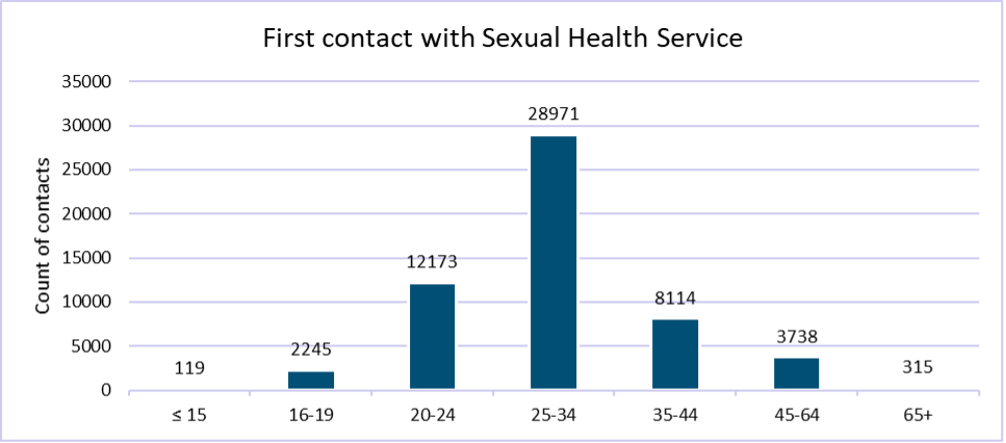
Age and Gender Distribution of New STI Diagnoses
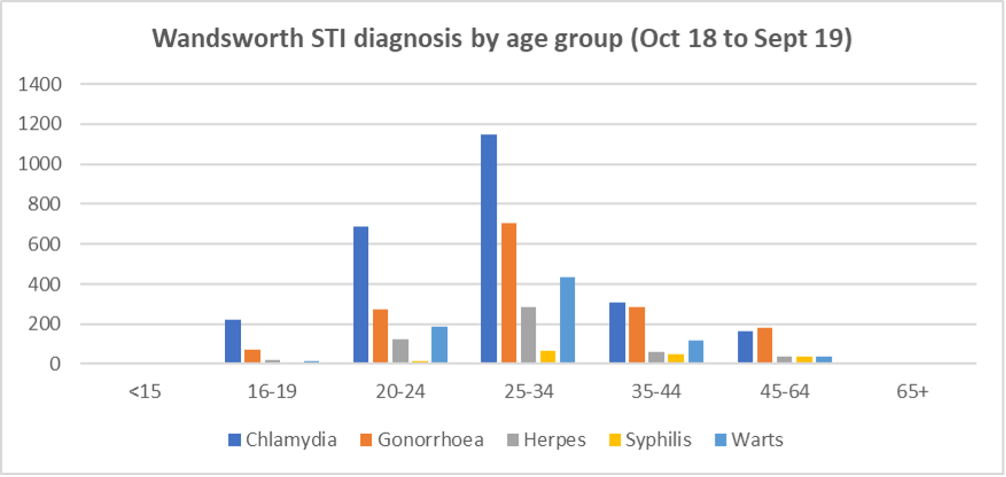
The age and gender distribution of new STI diagnoses (chlamydia,
gonorrhoea, herpes, syphilis, warts) in Wandsworth residents in 2018
highlights that the largest number of newly diagnosed STI’s are in the
25 to 34-year-old age cohort (figure below).
 Source:
GUMCAD Extracted Feb 2020
Source:
GUMCAD Extracted Feb 2020
Sexual Orientation
People identifying as LGBTQ+ can experience a greater degree of
health inequalities, including sexual health . National data shows
where gender and sexual orientation are known. MSM account for 29% of
London residents diagnosed with a new STI in a specialist health clinic.
90% have syphilis and 63% have gonorrhoea. In line with the national
picture, the amount of diagnoses of gonorrhoea and syphilis are higher
in gay men compared to heterosexual men (figure below).
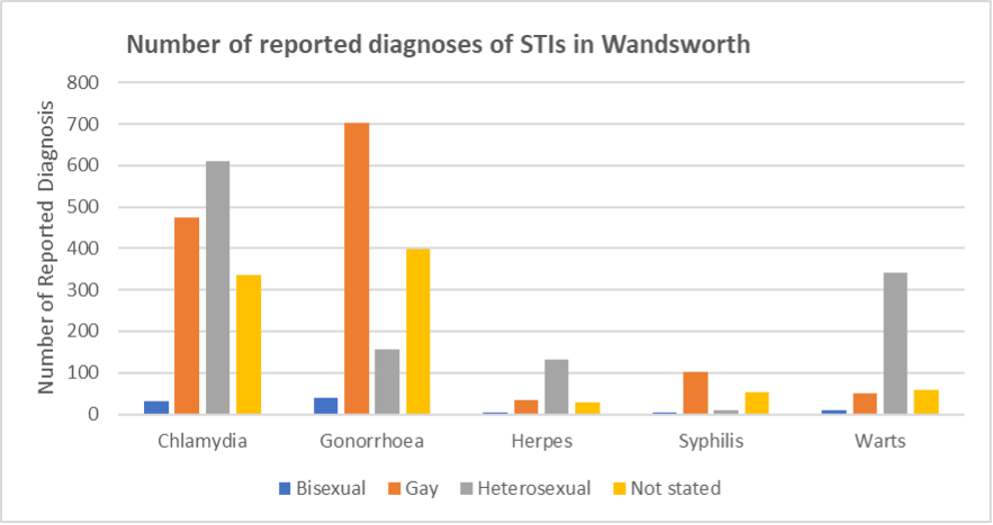
Count of STI diagnoses in Wandsworth by sexual
orientation
Source: GUMCAD Sep ’18–Oct ’19
When comparing new diagnosis of STIs by ethnic origin and sexual
orientation a larger proportion of white gay/lesbian are newly
diagnosed.
New STI Diagnoses (excluding Chlamydia in under 25s)
New STI
diagnoses (excluding chlamydia aged 24 years and under) per 100,000:
In 2025, Wandsworth’s rate was 1383.1 per 100,000 (n=4670),
which was the 12th highest in London, 213.5% higher than the England
average and 31.8% higher than the London average. The latest Borough
figure for 2025 was also 8.5% lower than in 2012, in comparison with
22.4% decrease in England’s rate in the equivalent time period.
Source: OHID:
Public Health Profiles
Gonorrhoea Diagnostic Rate
Gonorrhoea diagnostic rate per 100,000: In 2025, Wandsworth’s
rate was 434.2 per 100,000 (n=1466), which was the 10th highest in
London, 298.0% higher than the England average and 34.3% higher than the
London average. The latest Borough figure for 2025 was also 118.7%
higher than in 2012, in comparison with 117.0% increase in England’s
rate in the equivalent time period.
Source: OHID:
Public Health Profiles
Syphilis Diagnostic Rate
Syphilis
diagnostic rate per 100,000: In 2025, Wandsworth’s rate was 41.5
per 100,000 (n=140), which was the 14th highest in London, 194.2% higher
than the England average and 8.2% higher than the London average. The
latest Borough figure for 2025 was also 127.1% higher than in 2012, in
comparison with 150.2% increase in England’s rate in the equivalent time
period.
Source: OHID:
Public Health Profiles
HIV Prevalence
Note: Some figures and service descriptions in this
section have not been updated and may not reflect the latest available
data. They are retained to provide context and should be interpreted
alongside the more recent indicators presented elsewhere in this
chapter. The charts and the new and late diagnosis figures are current;
the treatment and e-service figures date from 2018/19.
HIV
diagnosed prevalence rate per 1,000 aged 15 to 59 years: In
2024, Wandsworth’s rate was 4.6 per 1,000 (n=1095), which was the 16th
highest in London, 89.6% higher than the England average and 9.8% lower
than the London average. The latest Borough figure for 2024 was also
4.2% lower than in 2011, in comparison with 22.1% increase in England’s
rate in the equivalent time period.
Source: OHID:
Public Health Profiles
The rate of new HIV diagnosis per 100,000 population in the borough
was 14.2 (2024), compared with 16.3 across London and 9.0 in England. In
2024, 48 adult residents were newly diagnosed with HIV. Combination HIV
prevention – including condom provision, pre-exposure prophylaxis
(PrEP), expanded HIV testing, and prompt initiation of treatment after
diagnosis – continues to be important in reducing new diagnoses.
In Wandsworth the E-Service during this period had HIV detection
rates for over 24 year olds of non-reactive 7,018 (99.7%) and reactive
21 (0.3%) while the numbers of postal test kits sent out by the newly
commissioned SH:24 service totalled 26 with 11 being processed. Most of
these kits were requested by people in the 25-34 age group (48.39%) and
by males (64.34%). 2 reactive results were produced from those kits
processed.
The vast majority (79.6%) of newly diagnosed patients with HIV in the
borough were put on Antiretroviral treatment (ART) within 91 days of
their diagnosis. Successful ART decreases a person’s viral load,
significantly reduces the risk of future transmission and transforms HIV
from a fatal infection to a chronic but manageable condition. In
2022–24, 31.0% of HIV diagnoses among Wandsworth residents were made at
a late stage of infection (CD4 count below 350 cells/mm³), compared with
39.2% in London and 43.3% in England . Numbers of new
diagnoses in a single borough are small, so this percentage can change
considerably from one period to the next. Late diagnosis is the most
important predictor of HIV-related morbidity and short-term mortality
and is a key component of evaluating the success of HIV testing
efforts.

5.2 Social Factors
Employment of Mental Health Service Users
Gap in the employment rate for those who are in contact with secondary mental health services and the overall employment rate: In 2021/22, Wandsworth’s rate was 76.9 percentage points, which was the 4th highest in London, 10.8% higher than the England average and 8.0% higher than the London average. Time series data were not available for this indicator.
Source: OHID: Public Health Profiles
Mental Health Service Users Living In Stable Accommodation
Adults in contact with secondary mental health services who live in stable and appropriate accommodation: In 2020/21, Wandsworth’s rate was 77.0%, which was the 9th highest in London, 32.8% higher than the England average and 26.2% higher than the London average. The latest Borough figure for 2020/21 was also 4.7% lower than in 2011/12, in comparison with 6.2% increase in England’s rate in the equivalent time period.
Source: OHID: Public Health Profiles